
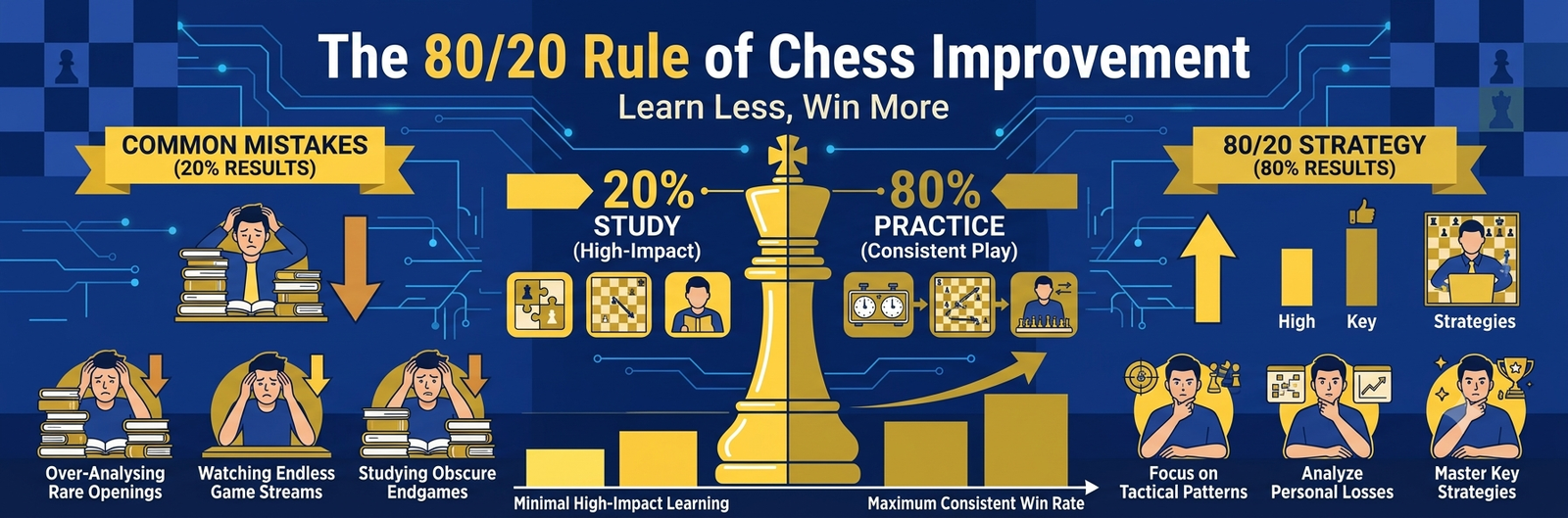
The 80/20 Rule of Chess Improvement: Learn Less, Win More
Discover Pareto’s Principle applied to chess. Stop memorizing endless opening lines and start focusing on the high-impact habits that yield 80% of your rating gains.
Quick Summary
The 80/20 principle at a glanceApplying the 80/20 Rule (Pareto Principle) means prioritizing tactical pattern recognition, basic endgame principles, and blunder reduction over complex opening theory. Over 80% of amateur chess games are decided by tactical blunders—not theoretical opening novelties. By narrowing your focus to core calculation and error prevention, you can maximize rating growth in a fraction of the time.
Table of Contents
1. Understanding Pareto’s Principle in Chess
For decades, chess players have operated under the assumption that getting better requires mastering every single aspect of the game—memorizing 20-move deep opening theory, solving endless complex endgame studies, and digesting massive strategy manuals.
However, the 80/20 Rule (Pareto’s Principle) dictates that 80% of your results come from just 20% of your efforts. In chess, this means the vast majority of your rating gains do not come from elite grandmaster theory, but from mastering a small set of high-impact core fundamentals.
Instead of spreading your limited study time thin across hundreds of obscure concepts, applying the 80/20 rule allows you to focus exclusively on the high-yield habits that actually decide amateur and intermediate games.
Over 80% of chess games under 2000 Elo are decided by basic tactical blunders, not subtle positional advantages. Study what actually wins games.
2. The Opening Trap: Why Studying Theory Wastes Time
The single biggest time-sink for developing chess players is opening preparation. Studying lines 15 moves deep feels productive, but it yields almost zero return on investment when your opponents deviate on move 4.
The 80/20 approach replaces rigid opening memorization with universal opening principles: control the center, develop your pieces toward active squares, and safeguard your king early.
Why opening theory fails amateur players:
- Low Return on Effort: Your opponent rarely plays the precise response you spent hours studying.
- False Sense of Security: Knowing the first 8 moves perfectly won't help when you blunder a piece on move 12.
- Fragile Knowledge: Memorizing moves without understanding concepts leads to devastating middle-game mistakes.
The 80/20 alternative for openings:
- Pick 1 flexible opening for White and 2 system-based responses for Black.
- Focus on piece placement goals rather than exact move sequences.
- Limit opening study to just 10% of your total chess study time.
3. The Vital 20%: Pattern Recognition and Tactics
If opening study represents the low-yield 80% of chess effort, **tactical calculation and pattern recognition** represent the vital 20% that yields massive rating growth.
Tactics are the fundamental building blocks of chess. Whether it is a simple fork, a pin, or a discovered attack, tactical opportunities arise in almost every single turn.
High-impact tactical patterns to master:
- Pins & Skewers: Freezing enemy pieces and exploiting alignment.
- Double Attacks & Forks: Forcing your opponent into making an impossible defensive choice.
- Deflection & Decoy: Removing defenders to open up king attacks or piece wins.
- Back-Rank Weaknesses: Exploiting vulnerable king positions instantly.
Daily, targeted practice with tactical puzzles builds automatic pattern recognition, enabling you to spot winning opportunities in seconds during real games.
4. Essential Endgames Every Player Must Master First
You don't need to learn hundreds of theoretical endgame positions to drastically improve your conversion rate. By focusing on a few universal endgame structures, you can reliably convert winning positions and rescue draws from losing ones.
Rook endgames make up over 50% of all real-world endgames, making them the most high-value area of endgame study available.
The 20% endgame toolkit:
- King & Pawn Basics: Opposition, key squares, and the square rule.
- Rook & Pawn Essentials: The Lucena position (how to win) and the Philidor position (how to draw).
- Basic Checkmates: Executing King + Queen and King + Rook checkmates effortlessly without stalling or stalemating.
Mastering these core positions gives you complete confidence in simplified positions, allowing you to liquidate material advantages without fear.
5. Blunder Prevention: The Highest ROI Chess Habit
Chess is less about playing brilliant moves and more about avoiding devastating blunders. In most amateur games, the player who makes the last major error loses.
By introducing a simple, mandatory **safety check** before making any move, you eliminate over half of your unforced errors instantly.
The 5-second blunder prevention routine:
- Check Checks, Captures, and Threats: What is my opponent attacking right now?
- Inspect the Landing Square: Is the square I am moving to defended by an unseen enemy piece?
- Verify Defender Status: Am I moving a piece away from a square that was actively defending something else?
Adopting this disciplined safety check routine will yield an immediate, permanent boost to your winning percentage.
6. A 30-Minute Daily 80/20 Chess Practice Routine
Consistency easily beats volume. Instead of exhausting 3-hour weekend study sessions, a focused 30-minute daily routine aligned with the 80/20 rule guarantees steady progress without burn-out.
Your daily 30-minute schedule:
- 10 Minutes - Tactical Pattern Recognition: Solve 10–15 fast-paced tactical puzzles.
- 15 Minutes - Focused Gameplay: Play one 10+0 or 15+10 rapid game applying strict blunder checks.
- 5 Minutes - Post-Game Review: Analyze your loss or win to identify the single critical moment where the game shifted.
This lean, high-efficiency structure optimizes time usage while driving continuous skill reinforcement day after day.
The Ultimate 80/20 Chess Rule
Stop trying to learn everything at once. Master tactical pattern recognition, eliminate unforced blunders, and learn basic endgame technique. Do those three things consistently, and you will outpace 90% of players who spend all their time memorizing opening theory.
7. Cultivating Psychological Resilience & Mindset
Beyond raw calculation, applying the 80/20 rule to chess requires a fundamental shift in your mental framework. Chess is a zero-sum game with no elements of luck; every victory and defeat is a direct result of the choices made on the board.
Developing players often fall into the trap of letting losses dictate their self-worth. Shift your focus away from immediate rating volatility and toward **process-oriented growth**. Over a 100-game sample size, consistent application of core habits will always win out over short-term luck.
Mental habits of high-efficiency players:
- Frustration Tolerance: Accept that blunders are essential data points, not personal failures.
- Emotional Regulation: Avoid "tilted" play—never immediately queue into another game after a devastating loss.
- Decisiveness: Execute plans confidently without overthinking or fearing ghost threats.
- Disciplined Time Management: Allocate your thinking time based on positional complexity rather than panicking in simple moves.
Players who view mistakes as free lessons progress exponentially faster than those who play endlessly on tilt trying to win back lost rating points.
8. Setting Realistic Rating Goals and Milestones
One of the fastest ways to lose motivation is setting vague or unrealistic expectations. When utilizing Pareto's Principle, your rating goals should mirror specific, measurable improvements in execution rather than arbitrary numbers.
Breaking down your rating journey into tactical milestones keeps your study plan focused on the vital 20% that matters most for your tier:
Developmental milestones for amateur growth:
- Under 1000 Elo (Foundations): Eliminate undefended piece giveaways. Perform a 5-second safety check on every move.
- 1000–1400 Elo (Tactical Mastery): Master basic 2-move tactics (forks, pins, skewers) and basic king & pawn endgames.
- 1400–1800 Elo (Positional & Endgames): Optimize piece activity, punish opponent pawn weaknesses, and master essential rook endgames.
Focus exclusively on the primary objective for your current tier. Once you eliminate unforced blunders, crossing 1200 Elo becomes almost automatic.
9. Final Verdict: Can You Really Learn Less and Win More?
When ambitious players ask, "Is it really possible to double my rating in half the study time?", the answer is a resounding yes—provided you cut out the fluff.
Most amateur players spend 80% of their time memorizing complex opening lines they will never play, only to lose their games to 2-move tactical mistakes. By reversing this formula, you achieve maximum progress with minimal wasted effort.
Summary of the 80/20 Chess Improvement Blueprint:
- Cut the Theory: Spend no more than 10% of your time on openings. Stick to fundamental center-control principles.
- Prioritize Tactics: Drill pattern recognition daily to instantly spot winning material opportunities.
- Enforce Safety Checks: Verify every landing square to eradicate unforced blunders before making a move.
- Master Basic Endgames: Learn Lucena, Philidor, and basic pawn endgames to guarantee victories in simplified boards.
Chess improvement isn't about working harder; it's about allocating your valuable time to the vital few habits that drive real performance gains.
Final Action Step: Start Your 80/20 Journey Today
You don't need to dedicate hours every night to get significantly better at chess. Close the theoretical textbooks, stop trying to memorize 20 moves deep into the Sicilian Defense, and simplify your routine.
Commit to just 30 focused minutes today: solve 10 tactical puzzles, play a single 15-minute game with strict blunder prevention checks, and quickly review your loss.
Stick to this lean routine for 30 days, and you will watch your rating rise while spending a fraction of the time studying.
Frequently Asked Questions
The 80/20 Rule (Pareto’s Principle) states that 80% of your chess gains come from just 20% of your study efforts. In chess, this means focusing heavily on tactical pattern recognition, blunder prevention, and fundamental endgames rather than spending dozens of hours memorizing complex opening theory.
Amateur and intermediate games under 2000 Elo are almost always decided by tactical blunders in the middlegame, not theoretical opening moves. Memorizing 15-move deep openings yields very low returns because opponents rarely follow mainlines, whereas tactical awareness applies to every single move of every game.
A focused 30-minute daily routine is far more effective than 3-hour marathon weekend sessions. Splitting your daily time into 10 minutes of tactical puzzles, 15 minutes of structured rapid gameplay, and 5 minutes of post-game review ensures rapid, consistent progress without burnout.
You only need to master a small handful of endgame principles to win most simplified positions. Focus on basic King & Pawn concepts (opposition, key squares), basic checkmates (King + Queen, King + Rook), and core Rook & Pawn positions like the Lucena (winning) and Philidor (drawing) techniques.
Implement a mandatory 5-second safety check before every move. Ask yourself: "What is my opponent attacking?", "Is the square I am moving to safe?", and "Am I leaving an existing piece undefended?" This single habit eliminates up to 50% of unforced tactical mistakes immediately.